
 Author: Allmark
  Publication Date: 2026-08-11
 Recently, the European Union Carbon Border Adjustment Mechanism (CBAM) has become an unavoidable compliance issue for companies exporting to the EU. For the steel structure industry, we have identified three key areas that business decision-makers need to focus on:

1. Understanding the Mechanism: From “Carbon Emissions” to “Carbon Costs”
CBAM is essentially a carbon pricing mechanism established by the EU for imported carbon-intensive products.
For steel structure products exported to the EU, primarily those covered by the relevant CN codes, the EU will impose a corresponding carbon cost based on the actual carbon emissions intensity generated during the manufacturing process.
In the second quarter of 2026, the average price in the EU Emissions Trading System (EU ETS) remained at EUR 75.28 per tonne of CO₂ equivalent, directly contributing to the marginal carbon costs faced by enterprises.
2. Key Milestones: Compliance Obligations Have Entered the Substantive Phase
As of January 1, 2026, CBAM officially moved beyond its transitional period and entered the definitive regime. Enterprises should pay particular attention to the following key dates:
Registration: EU importers must complete registration as Authorized CBAM Declarants by March 31, 2026.
Certificate Purchase: The purchase of CBAM certificates will officially open from February 1, 2027.
Settlement: For imported products covered by the 2026 calendar year, the final deadline for settlement is September 30, 2027.
This means that an enterprise’s production data for the entire year of 2026 will directly determine its cash-flow exposure in 2027.
3. Calculation Methodology: The Cost Gap Between Actual and Default Values
CBAM allows carbon emissions to be calculated using two approaches, with a significant difference in the resulting carbon costs:
Actual Values:
Enterprises establish an MRV (Monitoring, Reporting and Verification) system and, following verification by an EU-accredited verification body, submit their actual emissions data. Taking structural sections as an example, the carbon cost based on compliant actual emissions data is approximately RMB 64 per tonne.
Default Values:
When valid actual emissions data cannot be provided, the EU will require the use of country-specific default values, which are based on carbon-intensive, conventional production routes in China. Under the same conditions, the resulting carbon cost can be as high as RMB 1,414 per tonne.
It is worth noting that the country-specific default values will increase by 10% annually from 2026 onward. Based on an annual export volume of 10,000 tonnes, using default values could reduce annual profits by more than RMB 10 million.
Recommended Actions
We specialize in providing export-oriented enterprises with end-to-end CBAM compliance services aligned with international standards, including MRV system development, Monitoring Methodology Document (MMD) preparation, and coordination with EU-accredited verification bodies.
Given that complete production data for 2026 will serve as the basis for the 2027 settlement, we recommend that enterprises initiate their CBAM compliance preparations immediately to avoid unnecessary carbon cost exposure.
About Shanghai Allmark
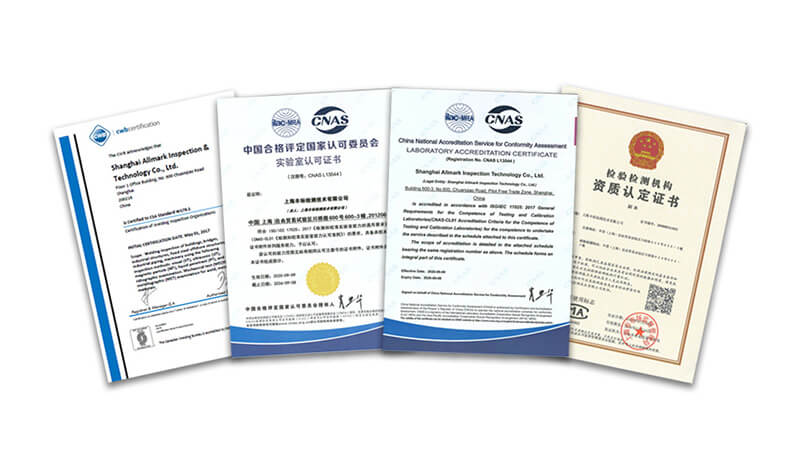
Shanghai Allmark Technology Service Co., Ltd. is the sole authorized partner and authorized organization of the Canada Welding Bureau (CWB) in China, specializing in international welding certification, education and training, inspection and testing, and technical services.
With a professional technical team and nearly 20 years of industry experience, Shanghai Allmark has developed into a leading certification consulting and technical service provider in China.
Contact Us
Contact: Mr. Yu
Mobile: +86-185 1657 3798
Email: hao.yu@allmark.com.cn
 Address: Room 101, 1F, Building 5 (T15-5), No. 999 Ningqiao Road, Pudong New Area, Shanghai
 Tel: +86-021-64128191
 Mobile: +86-185 1629 6670(Business)
 E-mail: info@allmark.com.cn














 Sign In
 Tel: +86-021-64128191
 Mobile: +86-185 1629 6670(Business)

 中文
中文 EN
EN