
 Author: Allmark
  Publication Date: 2026-08-13
Following the “cost gap between actual values and default values” discussed in the previous article in our CBAM series, as CBAM enters its definitive phase, this gap is no longer merely conceptual—it has become a real financial cost.
On July 6, 2026, the European Commission officially announced the CBAM certificate price for Q2 at €75.28 per tonne of CO₂, putting a clearly defined price tag on the carbon cost.Source: European Commission, Directorate-General for Taxation and Customs Union (DG TAXUD).
1. Default Values Are Not an “Alternative”—They Are a Penalty Mechanism
CBAM provides two calculation approaches: actual values and default values. However, default values are by no means simply a “second-best” alternative. Rather, they function as a clear penalty mechanism designed to incentivize companies to provide verified actual emissions data.
Taking the steel industry as an example, under European Commission Implementing Regulation (EU) 2025, the country-specific default value set for Chinese steel billets is approximately 3.169 tonnes of CO₂ per tonne of product—more than twice the EU benchmark value for carbon steel produced via the BF-BOF route, which is 1.370 tonnes of CO₂ per tonne of crude steel. This is reportedly the highest among major exporting countries.
According to estimates by the China Iron and Steel Industry Association based on data from 22 major steel producers, the average actual emissions of Chinese steelmakers are approximately 1.57 tonnes of CO₂ per tonne, meaning that the default value of 3.169 tonnes is roughly twice the actual emissions level.
More importantly, CBAM also incorporates a penalty uplift mechanism. According to the relevant EU implementing regulations, the default value will be increased by 10% above the benchmark level in 2026, by 20% in 2027, and by 30% from 2028 onward. The longer a company delays providing verified actual emissions data, the higher its potential carbon cost.
2. Steel Structure Companies: A More Significant Impact from Default Values
Steel structure products are classified as complex goods. Their embedded emissions consist of both emissions attributable to the production process itself and the embedded emissions of precursor materials.
Among these, the embedded emissions of precursor materials such as steel billets, sections and plates are estimated to typically account for 70%–90% of total embedded emissions, making them the dominant component of the carbon cost.
For most steel structure companies, precursor materials are sourced from multiple suppliers, making it difficult to obtain verified emissions data from upstream steel producers.
If default values must be applied to precursor emissions—with different default values applicable to different precursor materials—the accumulated carbon cost can be several times, tens of times, or even higher than the cost calculated using actual emissions data.
At the same time, although emissions from a company's own processing activities account for a relatively small proportion, CBAM rules specify that there is no default value available for emissions from the production process itself, meaning that these emissions must be calculated based on actual data.
In other words, companies face pressure from both ends.
3. The Time Window Is Narrowing
The production emissions data collected throughout 2026 will directly determine the amount to be settled in the first CBAM declaration and surrender process in September 2027.
As we have now entered Q3 2026, if emissions data for the first half of the year was not collected in accordance with the required methodology, companies may ultimately have to rely on default values.
With the penalty uplift increasing year by year, one principle is becoming increasingly clear:The longer you wait, the higher the cost.
Shanghai Allmark — Your Partner in CBAM Carbon Cost Optimization
As a professional CBAM consultancy, Shanghai Allmark has extensive knowledge of EU verification requirements and can support companies with:
Carbon cost assessment and emissions accounting
Precursor emissions data management
Planning for the actual-value calculation pathway
Preparation of MMD (Monitoring Methodology Documentation) in compliance with regulatory requirements
Design of standardized data collection procedures
Pre-verification services, helping companies familiarize themselves with and rehearse the verification process in advance, while identifying and addressing potential gaps
End-to-end support throughout the verification process, including pre-verification preparation, on-site assistance during verification, and follow-up on corrective actions after verification—providing a complete one-stop service
Our goal is clear:
To help our clients establish a solid cost advantage through reliable actual emissions data ahead of the first CBAM settlement on September 30, 2027. In carbon cost management, what you save directly strengthens your competitiveness.
Contact Us
Contact Person: Mr. Yu
Mobile: +86-185 1657 3798
Email: hao.yu@allmark.com.cn
Previous Post: No More
Next Post: MRV System and MMD: The Cornerstones of CBAM Compliance for Steel Structure Enterprises
 Address: Room 101, 1F, Building 5 (T15-5), No. 999 Ningqiao Road, Pudong New Area, Shanghai
 Tel: +86-021-64128191
 Mobile: +86-185 1629 6670(Business)
 E-mail: info@allmark.com.cn















 Sign In
 Tel: +86-021-64128191
 Mobile: +86-185 1629 6670(Business)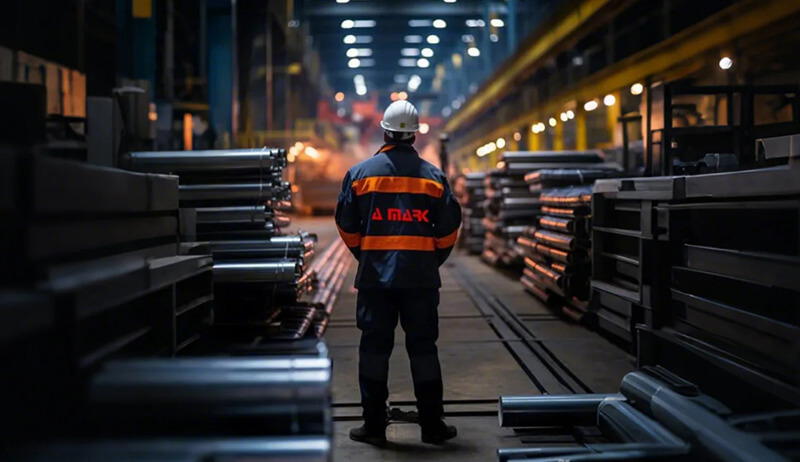


 中文
中文 EN
EN